
An emotional rollercoaster is the metaphor that I have used for many years to describe my grief to others. Being strapped in with no control, the anticipation of what will come next, panic, hearing my heart pounding in my head, and feeling dishevelled by the time the ride comes to a halt. Then calm, and life as I have come to know it now… until the ride starts again.
It wasn’t until I undertook grief training and studied the Dual Process Model of Coping with Bereavement (Stroebe & Schut, 1999) that I recognised this was what I had been describing all along. When I went on my own bereavement journey, I expected it to take a bit of time and I’d follow the different stages that I had read about. What I hadn’t expected was to feel exhausted by the conflicting emotions.
Grief doesn't move in one direction
After a loss, longing, sadness, painful memories and other emotions can feel overwhelming. Getting through each day is enough until, sometimes without even realising it, our attention shifts towards everyday life. We go to work, make dinner, laugh at something on TV, meet a friend, deal with the washing or do whatever needs to be done. And then grief can come crashing back in again.
The Dual Process Model was originally developed to describe coping with bereavement. It describes oscillating (I prefer to call it zig-zagging) between two different ways of coping with grief: loss-oriented and restoration-oriented. Loss-oriented times are those when our attention is drawn towards the loss itself. We may be remembering, longing, crying or experiencing the pain and emotions connected with our loss.
Restoration-oriented times are when our attention shifts towards living with what has changed. This might involve everyday tasks, work, relationships, taking on responsibilities or beginning to find our way in a life that now looks different. Importantly, we don't stay permanently in either one; we move between them.
The emotional rollercoaster
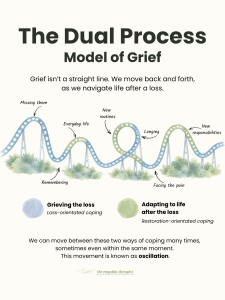
For me, this is where the emotional rollercoaster fits, and why I created the visual above.
We might spend a morning crying and an afternoon laughing. We can have a day when life feels almost normal, only to be knocked sideways by grief the next day. We might even experience both within the space of an hour. There can also be an extra sprinkling of guilt added to the grief because we have dared to feel a bit normal. We might wonder whether we should really be laughing, why we haven't felt the grief for the last few hours, or whether having a good day somehow means we're moving on.
There can be moments when the ride feels relentless and we desperately want to get off, and then there are times when things feel calmer and we can catch our breath. Neither means that we are grieving well or badly. Having a good day doesn’t mean we have forgotten what we have lost, and having a tough day doesn’t mean we have gone backwards.
Why we need time away from grief
One of the things I find particularly helpful about the Dual Process Model is the recognition that we cannot be completely immersed in our grief all of the time. Grieving takes energy, and moving our attention towards everyday life can give us periods of respite from the intensity of the loss. That doesn't necessarily mean we are avoiding our grief or pretending it hasn't happened. Sometimes, our attention simply needs to be somewhere else for a while.
And the movement can happen the other way too. We can be getting on with life when a song comes on, something reminds us of how life used to be, a familiar place catches us off guard, or we suddenly become aware again of what is missing in our lives. Back around the rollercoaster we go.
There is room for both grief and life
Perhaps one of the things I like most about the Dual Process Model is that it makes room for both. Grief can be painful and consuming, while life can still contain moments of laughter, connection and even fun. One does not cancel out the other.
Over time, the rollercoaster may change. The drops might not always feel as steep, or there may be longer stretches when the ride feels calmer. But there isn't a timetable for this, and there may still be moments when grief takes us completely by surprise.
We don't have to choose between grieving and living. It is entirely possible to have both.
If you are finding the emotional rollercoaster of grief difficult to navigate, counselling can offer somewhere to talk about what you are experiencing without needing to make your grief fit a particular timeline or set of stages. If you're looking for grief counselling in Stirling or online, you can find out more about how I work through my Counselling page.