
Sometimes, when we experience something overwhelming, we can become numb.
It can happen after a bereavement, during a period of intense stress, following a traumatic experience, or when life has simply felt like too much for too long. You may know that something significant has happened but feel strangely disconnected from it. You might carry on with work, look after other people, make dinner, answer messages and do all the things that need to be done. You are functioning.
For some people, that numbness can be frightening. There can be an expectation that we should be crying, grieving or reacting in a particular way, especially when something painful has happened. When those feelings aren't there, it's easy to wonder whether there is something wrong with us.
However, numbness can be part of how we respond when something feels too overwhelming to take in all at once. When the mind is faced with something that feels like too much to process, it can shift into a kind of protective mode. Rather than allowing us to feel the full emotional impact all at once, our response can sometimes be to disconnect or feel numb for a while. It isn't a conscious decision; it can be one of the ways our system helps us keep functioning when there is simply too much to process.
When numbness begins to thaw
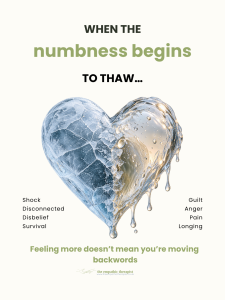
I created the Thawing Heart as a way of describing what can happen when the numbness begins to soften and feelings start to return.
We might imagine that beginning to feel again would automatically feel like progress. Perhaps there is an expectation that the numbness lifts and we simply start to feel better. But sometimes, the opposite can seem true.
As the numbness begins to thaw, feelings that had seemed distant can suddenly feel much closer. Sadness may become more intense. Anger can appear. There may be guilt, longing, anxiety or pain. Memories can surface unexpectedly, and things that you seemed able to cope with before may suddenly feel much harder.
It can leave you wondering, Why do I feel worse now? I thought I was coping.
You haven't necessarily gone backwards
This is something I think is particularly important when we talk about grief.
There is still an idea that grieving involves gradually feeling better as time passes, as though we move from being devastated towards being okay in one steady direction. In reality, grief can be far less predictable.
You may have periods when you feel relatively steady and others when the loss feels incredibly close again. You might cope with something enormous in the early days, only to find yourself overwhelmed months later by a song, a smell, an anniversary or an ordinary moment you didn't see coming.
Feeling more doesn't necessarily mean you're coping less. Sometimes, we only begin to recognise what we've been carrying when there is enough space for those feelings to come closer.
And I think there is something important in recognising that we don't need to be angry with ourselves for having felt numb. Our minds and bodies can be remarkably good at finding ways to help us through experiences we're not yet able to fully absorb.
There isn't one way to thaw
The Thawing Heart is a metaphor, not another model of how we're supposed to heal.
Not everyone experiences numbness, and for those who do, there is no timetable for when it should change. You may move between feeling numb and feeling everything intensely. You might even experience both at the same time in different parts of your life.
There also isn't a point at which your heart is supposed to become completely “thawed”.
Grief doesn't require us to reach a final state where everything has been processed, resolved or put behind us. Some losses become part of us. Our relationship with them may change over time, but that doesn't mean they stop mattering.
Making room for what is there
When difficult feelings begin to surface, our instinct can be to push them back down, particularly if they feel overwhelming. There may also be pressure from ourselves or other people to be doing better by now.
Having somewhere you can talk honestly about what is happening can help. Counselling won't tell you what you should be feeling or try to move you through your grief more quickly. It can offer somewhere to explore the sadness, anger, guilt, numbness, relief, confusion or whatever else is there, without having to make it neat or understandable for somebody else.
Sometimes, being able to say, “I don't understand why I'm feeling this now” is enough of a place to begin.
The thaw isn't the end of the story
I think that's what I like most about the image of the Thawing Heart.
It doesn't suggest that one day everything suddenly melts and we're healed. It leaves room for movement in both directions, for parts that still feel frozen, for feelings that come and go, and for the possibility that our emotional world can change without following a neat path.
If you've been feeling numb, you don't have to force yourself to feel. And if feelings have begun returning and you're finding that harder than the numbness was, that doesn't mean you're doing grief wrong.
You are allowed to meet whatever is there, at your own pace.
If you're looking for grief counselling in Stirling or online, you can find out more about how I work through my Counselling page.
The Thawing Heart © 2026 The Empathic Therapist Ltd. Created by Lynn Guthrie.