
When we think of grief, we often picture tears.
We imagine someone crying at a funeral, struggling to get through the day, or overwhelmed by sadness. Those moments are certainly part of grief, but they're only the part that other people can see.
Much like an iceberg, grief has a much larger hidden side. Whether your grief follows the death of someone close to you, the end of a relationship, a change in your health, the loss of a job, or another life-changing event, much of what you're carrying may remain unseen by those around you.
Through both my work as a counsellor and experience of grief, I've come to appreciate that while every person's story is unique, one thing many people have in common is the feeling that others can't see the full weight of what they're carrying. Life may appear to be moving forward, yet beneath the surface many people are working incredibly hard just to get through each day.
The Grief Iceberg is a reminder that grief is rarely as simple as it appears. What we see on the outside is often only a small part of what someone may be carrying beneath the surface.
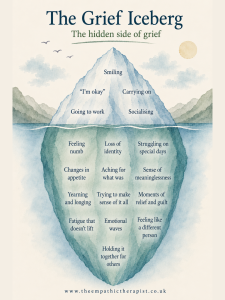
Take a moment to look at the iceberg
Before you read on, pause for a moment and look at the words beneath the surface.
You might recognise several of them immediately. Others may not resonate with you at all, and that's okay.
The Grief Iceberg isn't a checklist of how grief should feel. Instead, it's a reminder that grief is deeply personal, and much of what people carry remains unseen by those around them.
We only see the tip of the iceberg
Many people continue to smile, go to work, meet friends and tell others they're "fine." They may be caring for their family, supporting friends or simply doing their best to keep life going.
From the outside, it can look as though they're coping well. But grief doesn't disappear simply because it becomes less visible. Someone may be lying awake replaying memories, wondering how life changed so quickly, or simply trying to make it through another ordinary day without the person, relationship or future they imagined.
That's the part we rarely see.
The hidden side of grief
One of the reasons grief can feel so lonely is because much of it happens beneath the surface.
Many people think grief is only about sadness, yet it can affect almost every part of our lives. It can change the way we think, the way we experience the world around us, the way we see ourselves and even how we relate to the people we love.
If you found yourself recognising some of the words beneath the surface of the iceberg, you're not alone.
Many people quietly experience:
- Feeling numb
- Yearning and longing
- Trying to make sense of it all
- Moments of relief and guilt
- Loss of identity
- Feeling like a different person
- Struggling on special days
- Changes in appetite
- Fatigue that doesn't lift
- Emotional waves
- Holding it together for others
You may recognise many of these experiences, or only one or two. You may even find there are parts of your own grief that aren't captured here at all. That's because grief is as individual as the relationship, person or life that has been lost. There isn't a right or wrong way to experience it.
Grief doesn't follow a straight line
One of the biggest misconceptions about grief is that it follows a straight line.
While many people gradually learn to live alongside their grief, it rarely unfolds in a predictable way. Some days may feel manageable, while others can feel unexpectedly heavy. A familiar song, a birthday, an anniversary or even an everyday moment can suddenly bring a wave of emotion that feels as though it has come from nowhere.
That doesn't mean you're moving backwards. It simply means grief continues to be part of your story.
There are no milestones to reach and no timetable to follow. Grief has a way of unfolding in its own time, often reminding us that love and loss remain connected long after everyone else expects life to have returned to normal.
There is no right or wrong way to grieve
No two people experience grief in exactly the same way.
Some people need to talk, while others need silence. Some return to work quickly, whereas others find everyday tasks overwhelming. Some cry often, while others hardly cry at all.
The Grief Iceberg isn't a checklist of what you may experience. It's simply a reminder that grief is deeply personal. Your experience won't look exactly like anyone else's, and it doesn't need to.
What lies beneath the surface?
Perhaps the biggest lesson the iceberg teaches us is this: we never truly know what someone else is carrying.
The colleague who seems fine. The friend who is always smiling. The neighbour who has returned to work. Each may be living with a hidden side of grief that nobody else can see.
The same compassion is important for ourselves, too. If you're grieving, you don't need to compare your experience with anyone else's or wonder whether you're doing it "properly." Whatever your loss, whatever your story, your grief deserves kindness, patience and understanding.
The next time you look at an iceberg, remember that most of it lies hidden beneath the water. Grief can be like that too.
The smile. The conversation. Returning to work. Meeting friends for coffee. Posting on social media. These moments can make it look as though someone is coping, but beneath the surface may be longing, exhaustion, memories that arrive without warning, questions that have no answers, or the quiet work of learning to live alongside a loss that has changed life forever.
Perhaps the Grief Iceberg isn't simply about understanding grief. Perhaps it's a gentle reminder that we never truly know what someone else is carrying, and maybe that's enough to encourage us to offer ourselves—and one another—a little more patience, kindness and compassion.
If reading this has helped you recognise something of your own experience, I hope it also reassures you that there is no right or wrong way to grieve.
Update – July 2026
Since this illustration was first published, it has been viewed more than one million times across social media and shared thousands of times around the world. What has meant even more to me than the numbers has been reading the comments from people who recognised themselves in the iceberg, felt understood, or used it to help explain their grief to someone else.
I created the Grief Iceberg through a combination of my own experience of grief and the privilege of walking alongside clients in theirs. Although every person’s grief is unique, I hope it continues to remind people that what we see on the surface is rarely the whole story.
You don't have to carry everything beneath the surface alone.
If you're finding grief difficult to carry on your own, counselling can offer a safe and supportive space to explore your thoughts and feelings at your own pace. You don't have to have the right words or know where to begin. Sometimes, simply having someone alongside you can make all the difference.
You might also find these blogs helpful