
Grief doesn’t always become smaller with time, which can leave people wondering if they’re grieving “wrong”. Tonkin’s Model of Grief offers a different perspective, showing how life can gradually grow around grief without asking us to leave it behind.
Most of us grow up believing that grief gets smaller with time. That each passing week, month or year somehow chips away at the pain until one day we’ve “moved on.” For many people, though, that simply isn’t their experience.
One of the grief models I come back to time and time again, both personally and in my work with clients, is Tonkin’s Model of Grief. Rather than suggesting that grief gradually becomes smaller, Lois Tonkin proposed something quite different. What if the grief itself stayed much the same, but life slowly began to grow around it?
When grief first enters our lives, it can feel as though it fills everything, seeping into all of the tiny cracks. It can be difficult to imagine enjoying anything again, making plans, laughing, or even feeling like yourself. Grief can become the lens through which everything is experienced.
Over time, something begins to change. Not necessarily the grief itself, but the space around it. There may be moments of connection with other people, a return to work, finding comfort in familiar routines, allowing yourself to rest, making new memories, or discovering hope for the future. None of these things replace what has been lost, and they don’t mean that the grief has disappeared. They simply become part of life alongside it.
The illustration below is my own interpretation of Lois Tonkin’s Growing Around Grief model.
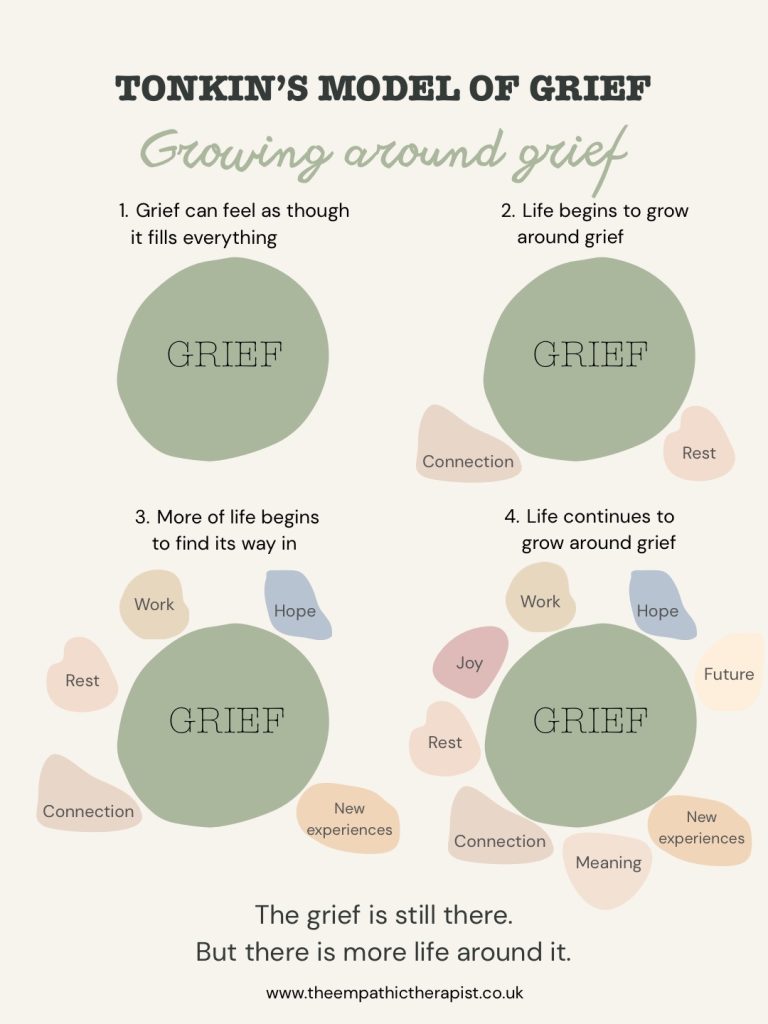
One thing I think is important to say is that this isn’t a blueprint. The four images aren’t stages that everyone moves through in order. Grief doesn’t work like that. There may be days, months or even years later when it once again feels as though grief fills everything. Anniversaries, birthdays, unexpected memories or significant life events can bring those feelings rushing back.
That doesn’t mean you’ve gone backwards. It means that you’re human.
One of the reasons I value this model so much is because it removes the pressure to “get over” grief. Instead, it offers grace to carry our grief while continuing to live our lives. We don’t have to choose between remembering the person we lost and allowing ourselves to experience happiness again. The two can exist together.
When I created the illustration above, I wanted to show that idea in a slightly different way. The grief remains exactly the same size throughout, while other parts of life gradually begin to appear around it. Everyone’s pebbles will look different. For some, it might be family or friendship. For others, work, purpose, hope, rest, joy or new experiences. There isn’t a right order, and there certainly isn’t a time limit.
If there is one thing I hope you take away from this model, it’s this:
The grief is still there. But there is more life around it.
If you’re finding grief difficult to carry, you don’t have to do it alone. Counselling can provide a safe, confidential space to explore your thoughts and feelings at your own pace. If you’d like to find out more about how I work, you’re very welcome to get in touch.
Further Reading
If you’d like to learn more about grief and bereavement, you may also find these articles helpful:
- Understanding Grief: A Guide to Navigating Loss – exploring the many ways grief can affect us and why every person’s experience is unique.
- The Grief Iceberg: What Grief Looks Like Beneath the Surface – understanding the thoughts, emotions and experiences that often remain hidden from others.
- Grief Counselling – find out how counselling can support you as you navigate grief at your own pace.