
Most of us have heard of the five stages of grief: denial, anger, bargaining, depression and acceptance. It's a model that's become so familiar that we often think of these stages as something we're supposed to work through, one after another, until we eventually reach acceptance.
But I've been wondering whether this idea is always helpful, particularly when someone's experience of grief looks nothing like that. Because the reality is, grief rarely follows such a straightforward path.
Where Did the Five Stages of Grief Come From?
The five stages were introduced by psychiatrist Elisabeth Kübler-Ross in her 1969 book On Death and Dying. What many people don't realise is that her work originally focused on people who were facing their own deaths, rather than those who had experienced a bereavement.
Over time, the model became widely associated with bereavement, and the five stages became a familiar way of describing some of the feelings people might experience after losing someone.
The original five stages are:
- Denial: Struggling to take in or believe what has happened.
- Anger: Feeling angry about the loss, the circumstances or the unfairness of it all.
- Bargaining: Thinking about what might have happened differently, often accompanied by thoughts of 'if only'.
- Depression: Experiencing sadness, emptiness or the weight of the loss.
- Acceptance: Beginning to acknowledge the reality of what has happened, even when it remains painful.
I can understand why these descriptions might be helpful. Sometimes, simply having a name for what we're feeling can make an experience a little easier to understand. But grief is rarely as straightforward as five descriptions on a page.
Over the years, the original model has been adapted and expanded, including into what's commonly known as the Seven Stages of Grief (The Loss Foundation, n.d.). This version includes other experiences, such as shock, guilt, pain, hope and adjusting to life after a loss.
And whilst these expanded versions recognise more of what someone might experience, they still can't tell us exactly how we're going to grieve. Whether we're talking about five stages, seven stages or something else entirely, no single model can capture everyone's experience.
Grief Doesn't Follow a Straight Road
In my counselling work, I've sat with people who are grieving the death of someone they love, and I've often been asked, "Which stage am I at?" It's an understandable question, particularly when we've grown up hearing about the five stages and assume there must be an order to them. It's not a question I can give a definitive answer to, and I think that's an important part of helping someone understand that grief doesn't follow a set pattern.
We might imagine that we begin with denial, move through anger, bargaining and depression, and eventually arrive at acceptance. But what happens when we feel angry one day, a little more accepting the next, and then find ourselves overwhelmed by sadness or disbelief again? It's easy to start wondering whether we've gone backwards or whether we're somehow doing grief wrong.
But grief doesn't work to a timetable. We might experience several feelings at once, return to emotions we thought had settled, or never experience some of the stages at all. And none of that means we're doing anything wrong.
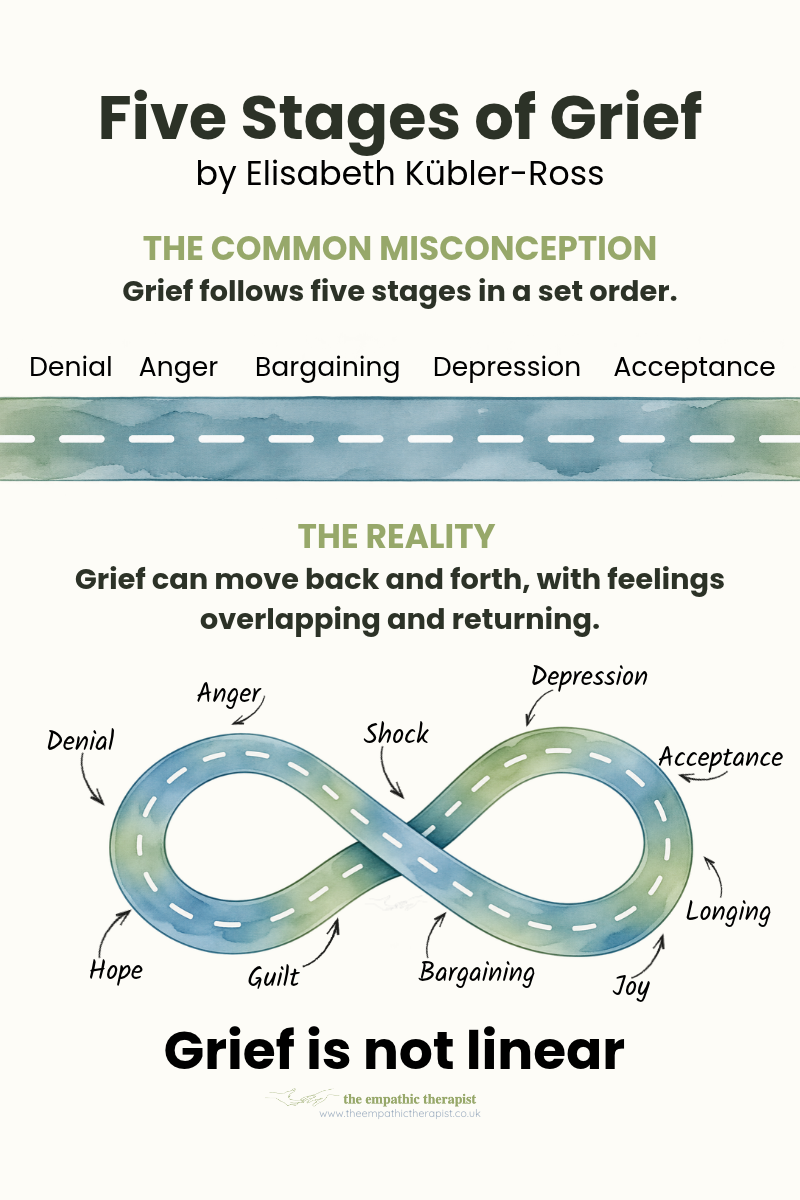
Why I Created the Road Visual
I wanted to create something that showed the difference between how the five stages are often presented and what grief can actually feel like. The straight road represents the common misconception that we move neatly from one stage to the next, eventually reaching acceptance at the end.
The looping road tells a different story. We might revisit feelings we thought we'd worked through, experience several emotions at the same time, or find that something we were coping with yesterday feels much harder today.
Of course, the looping road isn't another grief model, and I'm certainly not suggesting that everyone follows the same twists and turns. It's my way of illustrating that we can move back and forth between different feelings, sometimes in ways we didn't expect.
Does That Mean the Five Stages Aren't Helpful?
Not at all. I think models like this can be useful when they help us understand something we're struggling to put into words. Recognising feelings of anger, disbelief or sadness can help us make sense of what we're experiencing, particularly when everything feels confusing or unfamiliar.
Where I think we need to be careful is when we start treating those stages as a checklist. If we believe we're supposed to experience every stage in a particular order, we might begin questioning ourselves when our grief doesn't fit.
And what about acceptance? Does reaching acceptance mean we're no longer sad, that we've come to terms with everything, or that we're ready to move on? I don't believe it does. We can acknowledge that someone has died whilst still wishing things were different, still missing them terribly and still having days when their absence feels overwhelming.
Acceptance doesn't mean we have to be okay with what happened, and it certainly doesn't mean we have to stop grieving.
There Is No Right Order to Grief
Something I often come back to in my counselling work is how individual grief really is. Our experiences are shaped by the relationship we had with the person we've lost, the circumstances of their death, our previous experiences of loss and what's happening in our lives at the time.
We might have a day when we feel more like ourselves, enjoy spending time with friends or find ourselves laughing at something, only to be hit by a wave of sadness later. That doesn't mean we've gone backwards. It's part of how unpredictable grief can be.
I've explored this movement between different feelings and experiences in my article The Emotional Rollercoaster of Grief: Why Grief Can Feel So Unpredictable.
I think it's important that we don't turn grief into another thing we're supposed to get right. There are enough expectations placed on people who are grieving without adding the pressure of reaching a particular stage or feeling a certain way by a certain point.
The five stages might help us put words to some of our experiences, but they don't determine how we should grieve. And having a difficult day after a more manageable one doesn't mean we've undone anything.
There is no correct order, no fixed timetable and no single way to experience loss.
References
Kübler-Ross, E. (1969). On death and dying. Macmillan.
The Loss Foundation. (n.d.). Making sense of grief: Models, theories, and ways of understanding loss. https://thelossfoundation.org/grief-bereavement/making-sense-of-grief-models-theories-and-ways-of-understanding-loss/