
When someone dies, we often hear people talk about letting go, moving on or finding closure. But what happens to the relationship we had with that person? Does it end when they die, or does it become something different?
I believe there is something important about recognising that whilst someone may no longer be physically present in our lives, the relationship we had with them can continue in many different ways. In my work with clients, I've seen how the idea that a connection can continue after death can bring some comfort. For others, the concept of continuing bonds may not offer comfort, for reasons that are personal to them.
What is Continuing Bonds Theory?
In 1996, Dennis Klass, Phyllis Silverman and Steven Nickman edited Continuing Bonds: New Understandings of Grief, bringing together perspectives that challenged earlier understandings of grief, in which emotional detachment from the person who had died was often seen as a necessary part of grieving.
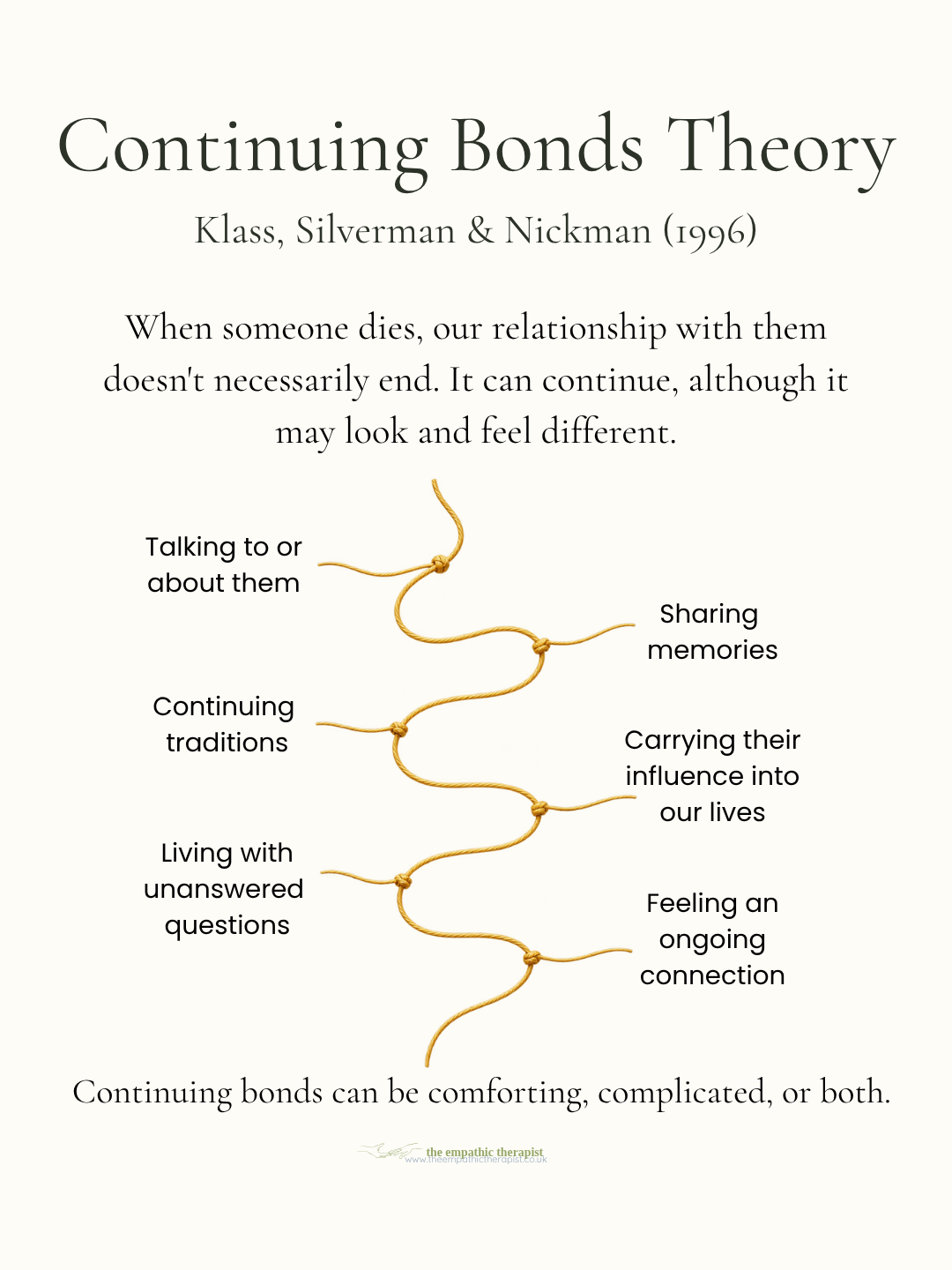
Continuing Bonds Theory recognises that we can maintain a connection with someone after their death whilst continuing to live our own lives. That connection may change over time, and what it looks and feels like will be different for each of us. I've created this illustration to explore some of the ways in which we might experience continuing bonds.
What might continuing bonds look like?
We may find ourselves talking to or about the person who has died, telling them about our day, wondering what they would say about something or simply mentioning them in everyday conversation. Sharing memories can also be a way of keeping someone present in our lives, whether that's through looking at photographs, telling familiar stories or remembering something that made us laugh.
We might continue traditions that were important to them, cook a particular meal, visit a familiar place or do something that we once enjoyed together. Sometimes we carry their influence without even realising it, through the expressions we use, the values we hold or the way we approach certain things in life.
For some of us, that connection may involve living with unanswered questions, conversations that never happened or things that were left unresolved. For others, there may be an ongoing sense of connection that is difficult to put into words. These are some examples of how a relationship might continue after death. They are not things we should be doing, nor are they experiences that everyone will relate to. If you'd like to explore more about the different ways we experience loss, I've written about this in my article Understanding Grief: A Gentle Guide.
When the relationship was complicated
I think it's important to acknowledge that continuing bonds aren't always about love, happy memories or finding comfort. Not all relationships are straightforward, and death doesn't necessarily resolve the complexities of a relationship. We may still find ourselves affected by things that were said or done, wondering why someone behaved as they did, or grieving the relationship we wished we could have had.
We might feel sadness alongside relief, anger alongside affection, or find ourselves missing someone with whom we had a difficult relationship. The connection we have with someone after their death can be comforting, complicated, or both. There is no expectation that we should remember someone in a particular way, maintain a connection that feels painful or feel differently about them simply because they have died.
Continuing bonds at Christmas and other significant occasions
As we approach the festive season, we may become more aware of the ways in which our relationships with those who have died continue to be part of our lives. Christmas, birthdays, anniversaries and other significant occasions can bring memories, familiar traditions and someone's absence into sharper focus. We may find comfort in continuing something we once did together, or we may find that a tradition no longer feels right for us.
Some people choose to introduce new ways of remembering someone, whilst others prefer not to mark the occasion at all. What feels right one year may feel very different the next. Christmas had always been a special time in our family, and after my mum died, it felt different. For the first year, we kept to the same traditions, but the following year we decided to create a new way of celebrating, whilst still honouring her memory.
Our relationship with someone who has died can continue to change, just as we continue to change. Moving forward with our own lives doesn't necessarily mean leaving that person behind. If you would like to explore your own experience of grief or the complexities of a relationship following someone's death, counselling can offer a space in which to do so, without judgement or expectation.
References
Klass, D., Silverman, P. R., & Nickman, S. L. (Eds.). (1996). Continuing bonds: New understandings of grief. Taylor & Francis.